
THE TRUMP-XI MEETING: CHINA’S PLACE IN US FOREIGN POLICY STRATEGY
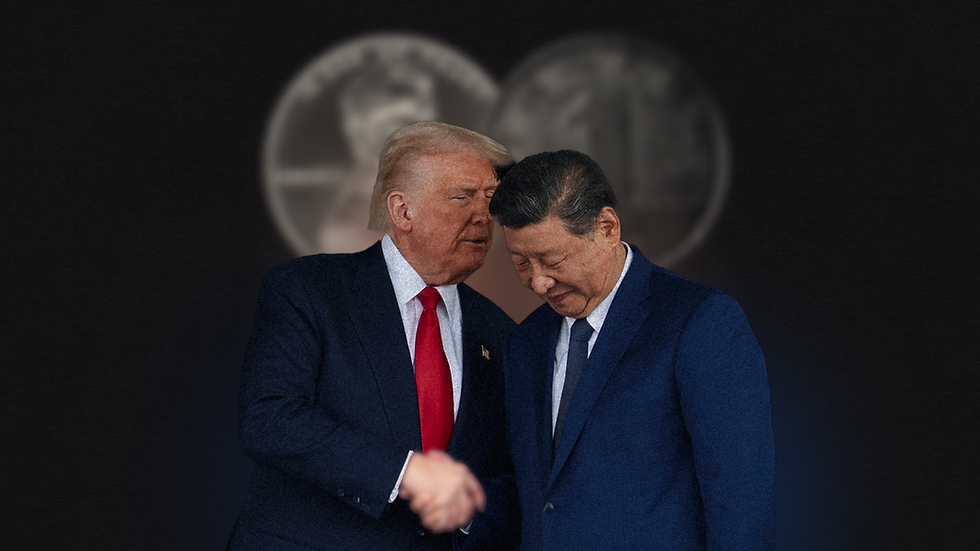
China has traditionally occupied a special place in American foreign policy. For a long time, bilateral relations were predominantly based on partnership but over the past fifteen years, they have increasingly been characterised as intense competition or even confrontation. President Donald Trump’s policy combines both the legacy of a long partnership and the new geopolitical realities in which Beijing is frequently set against Washington.
US-China relations at the end of the twentieth century were primarily characterised by trade and economic interests. The desires to open the Chinese market to American companies and to integrate China into the global economy were the driving forces behind the development of engagement between Washington and Beijing.
From a geopolitical standpoint, it was important for the United States to maintain a partnership with China to compete with the USSR. To some extent, it also helped to balance against Japan as an economic threat. Crises in bilateral relations arose periodically, such as following the suppression of protests in Tiananmen Square or escalation in the Taiwan Strait, but economic interests prevailed and provided an incentive to develop cooperation. It is worth noting, however, that as early as the 1993 US National Security Strategy, America’s policy was to carefully watch China’s emergence on to the world stage and support, contain, or balance it as necessary.
At the turn of the millennium, economics and trade continued to dominate US-China relations. Short-term crises, as in previous decades, did not impede the continuation of constructive engagement. During this period, China’s rapid economic development began to translate into a stronger geopolitical position and growing ambitions.
By the mid-2000s, the United States had come to see China as an important player not only regionally but globally. This drove the continued development of their partnership, and support for Beijing’s ‘responsible role’ on the world stage in trade, technology, and geopolitics.
George W. Bush’s administration primarily sought to balance China through bilateral relations with other East Asian countries. Due to his focus on the Middle East, though, it was not a foreign policy priority.
With Barack Obama’s arrival in office and throughout his two terms, US engagement in the region increased, while the desire to balance China persisted alongside support for and development of partnership relations.
The Obama administration placed emphasis on building networks of regional multilateral formats that excluded China. Meanwhile, China independently began developing its own regional and international cooperative frameworks. This approach on both sides contributed to growing mistrust between Washington and Beijing, though it is worth noting that shared platforms for discussing integration processes were maintained.
With the beginning of Donald Trump’s first term, the United States adopted an aggressive policy towards China through the imposition of tariffs and intensified anti-China rhetoric. At the same time, regional multilateral formats lost their previous importance for the US and the administration returned to developing bilateral relations with Washington’s East Asian partners.
Through decisive action, Trump sought to achieve longstanding American objectives vis-à-vis China: opening the domestic market to American companies, increasing Chinese purchases of American goods, and establishing ‘fair’ competition. An important outcome was an interim trade agreement between the two countries, although this was not fully implemented.
Under Joseph Biden, China was designated the “most consistent geopolitical challenge” facing the United States. At the same time, the American government acknowledged that the US-China relationship combined close partnership and intense rivalry. On this basis, a policy of containment was to be balanced by the preservation of close ties, particularly on issues of global and regional importance. Economics and trade remained key areas but were no longer dominant.
As under Obama, the Biden administration emphasised building networks of regional partnerships to act as a counterweight to Beijing’s expansion. This involved working within the existing Quad format - the four-way security dialogue between the United States, Japan, Australia, and India - and establishing AUKUS - the trilateral defence pact between Australia, the United Kingdom, and the United States.
In the US National Strategy adopted at the start of Donald Trump’s second term, China features primarily in the trade and economic sphere. This Trump administration sees a growing trade deficit and has set the goal of fundamentally ‘rebalancing’ its economic relations with Beijing. Longstanding objectives such as opening China’s domestic market to American companies, establishing ‘fair’ competition, and curbing the activities of state-subsidised companies remain on the agenda but are now subordinated to the goal of economic rebalancing. Accordingly, Trump approaches the containment of China primarily through economic and trade tools, as reflected in the tariff war of early 2025.
With his meeting with Xi Jinping in May 2026, Trump sought to translate the protracted negotiations between American and Chinese representatives into tangible results. A delegation of top business figures signalled the desire to once again attempt to ‘open’ China’s domestic market to American companies with little or no presence there, such as Visa, and to announce contracts for large-scale Chinese purchases of American goods.
The outcomes of Trump’s visit were significant but fell well short of what he hoped for. China agreed to increase their purchases of American agricultural products and for Chinese airlines to buy 200 Boeing aircraft. This deal is considerably more limited than the 2019 agreements, which themselves did not resolve the fundamental tensions in the bilateral relationship.
Questions of China’s domestic policy, such as on human rights and Tibet, went predictably unmentioned. This once again confirms the current American administration’s thoroughly pragmatic approach to foreign policy, despite Republicans traditionally having taken a highly critical stance on the actions of the CCP at home.
Discussion of Taiwan’s status was a priority for the Chinese side, as evidenced by the prominent coverage of Xi’s statements in Chinese state media. Despite its disregard for democratic values and alliance commitments, the Trump administration’s official documents acknowledge the importance of maintaining the status quo in the Taiwan Strait and supporting the democratically elected government of Taiwan. The US National Strategy also emphasises the need to prevent any single state from dominating the East China Sea, let alone fully controlling it.
Gaining control of Taiwan would, beyond capturing semiconductor production, open the path for Beijing to dominate the region. This is precisely why Trump was quick to state that he had made no commitments on Taiwan, while Rubio, Johnson, and other officials affirmed that the US position towards the island’s government remained unchanged.
Trump’s transactional approach to foreign policy and his desire for tangible gains will likely drive his actions on Taiwan. By reducing arms sales to Taiwan, the American president will seek concessions from China, while simultaneously pressuring official Taipei with the threat of suspended security support in exchange for investment and the relocation of manufacturing capacity.
China’s other priority was to secure a degree of ‘predictability’ from Trump in the bilateral relationship, insofar as that is possible. China’s economy is going through difficult times, and any trade instability would hit exports and worsen an already challenging situation. The creation of two new councils - on trade and on investment - will open additional channels of communication with the American side and provide greater control over developments.
At the same time, Trump is not currently in a sufficiently strong position to resume the tariff war with its previous intensity. The US Supreme Court’s ruling that Trump’s unilateral tariffs were unlawful is a crucial restriction on the president. The new bilateral bodies therefore give the US an opportunity to pursue results on economic issues through negotiation instead.
Partnership and competition remain closely intertwined in US-China relations. As in his first term, Trump has attempted to dictate the terms of the economic relationship between Washington and Beijing, but has been unable to achieve even a comparable result. In China, a sluggish economy does not allow Xi to mount a decisive challenge to Trump; instead it pushes him to keep Trump close in order to avoid instability.
Billi-Villi is an analytical media outlet that explains the mechanics of decisions, the motivations of politicians, hidden interests, and consequences affecting the situation in the world and in Ukraine today.


Comments